

Task mining tools capture desktop-level activity, such as clicks and keystrokes, to reveal how work happens and where automation opportunities exist. This guide compares the top 10 task mining tools in 2026, including Mimica, UiPath, and Celonis, on privacy approach, robotic process automation (RPA) integration, and readiness for agentic artificial intelligence (AI) deployment.
Top 10 Task Mining Tools in 2026: A Complete Buyer's Guide and Comparison
Task mining tools capture and analyze desktop-level activity, such as keystrokes, clicks, and application navigation, to reveal how work is actually performed across an organization. That data uncovers automation opportunities, quantifies inefficiencies, and increasingly feeds the design of AI agents that need an accurate picture of a process before they can execute it.
This guide compares the top task mining tools in 2026: what each one captures, what you get out of it, and where it fits into a broader automation or agentic AI program.
How do the top task mining tools compare?
The table below compares the ten leading task mining tools by best fit, category, privacy approach, and readiness for agentic AI deployment, so you can narrow the field before digging into the details on each one.
How do you choose the right task mining tool?
The right task mining tool depends on your primary use case, your privacy and compliance requirements, your existing platform ecosystem, your organization's scale, how quickly you need results, and whether you need automatic ROI quantification.
Consider these capabilities as you do your research and build your business case.
Breadth of capture. Does the tool record all desktop activity across every application, or does it sample selectively? And does it work across different operating systems, like both Windows and MacOS? Workflows don't always happen in one specific app, but rather across multiple systems. A tool that only captures a single app is less likely to reflect actual reality.
Subject matter expert (SME) and employee control over recording. Does the platform give the people being recorded direct control over when it happens, such as starting, stopping, or pausing a session themselves, or is recording dictated entirely by IT with no visibility to the employee? Tools that put control in the SME's hands tend to see faster buy-in and less internal pushback during rollout, since employees aren't left wondering when they're being watched.
How personally identifiable information (PII) gets redacted. Some platforms require manual configuration of redaction rules or allow-lists before they can safely capture sensitive data. Others detect and redact PII automatically, with no configuration required, so identifiable information never makes it into a stored recording in the first place. For financial services, healthcare, and government buyers, automatic redaction is often a hard procurement requirement, not a preference.
Integration with your automation stack. Does the tool feed directly into your robotic process automation (RPA) platform or process mining tool, or does it operate independently of both? How well it fits your existing ecosystem determines how quickly insights turn into action.
Agentic AI readiness. Does the output include structured context (decision logic, exception handling, escalation paths) that an AI agent can consume directly? AI pilots tend to fail because they don't have enough context upfront; your task mining tool should provide the necessary detail to build a successful AI program.
Output formats. What do you actually walk away with? Some platforms hand you a dashboard and little else. Others export process description documents (PDDs), standard operating procedures (SOPs), or Business Process Model and Notation (BPMN) diagrams, formats you can hand directly to an auditor, a developer, or an RPA team without translating the data yourself first.
Conversational access to your data. Once a platform captures process data, how do you actually get answers out of it? Some tools require someone to build dashboards or run manual analysis every time a question comes up. Others include a conversational AI interface that lets anyone on the team ask questions directly, such as where time is going or which steps are causing delays, and get an answer without waiting on an analyst.
Time to value. Some platforms need months of professional services before they're operational. Others start recording within days with no setup at all. Confirm what "deployed" actually means to a vendor before signing anything.
ROI quantification. Does the platform provide ROI insights, or does that require manual spreadsheet modeling after the fact? For teams that need to build a business case quickly, this difference matters more than almost anything else on this list.
What are the top 10 task mining tools in 2026?
The ten platforms below represent the leading task mining tools in 2026, ranging from purpose-built process intelligence platforms to RPA-native discovery tools and ERP-correlated process mining vendors.
1. Mimica
Mimica was built from the ground up to capture how work actually happens and turn it into structured, automation-ready process data, using a proprietary hybrid of OS-level querying and computer vision. Getting started takes minutes: SMEs simply turn recording on, and once it's running, no manual tagging or setup is needed to turn raw activity into process maps.
Key strengths:
- No limitations on which applications or systems get captured, including the workarounds and exceptions that never show up in a system log
- Seamless setup: recording starts with the click of a button, with no manual tagging, labeling, or configuration required afterward
- Works across both Windows and MacOS, uncommon in this category
- Automatically detects and redacts personally identifiable information, with no manual configuration of redaction rules required
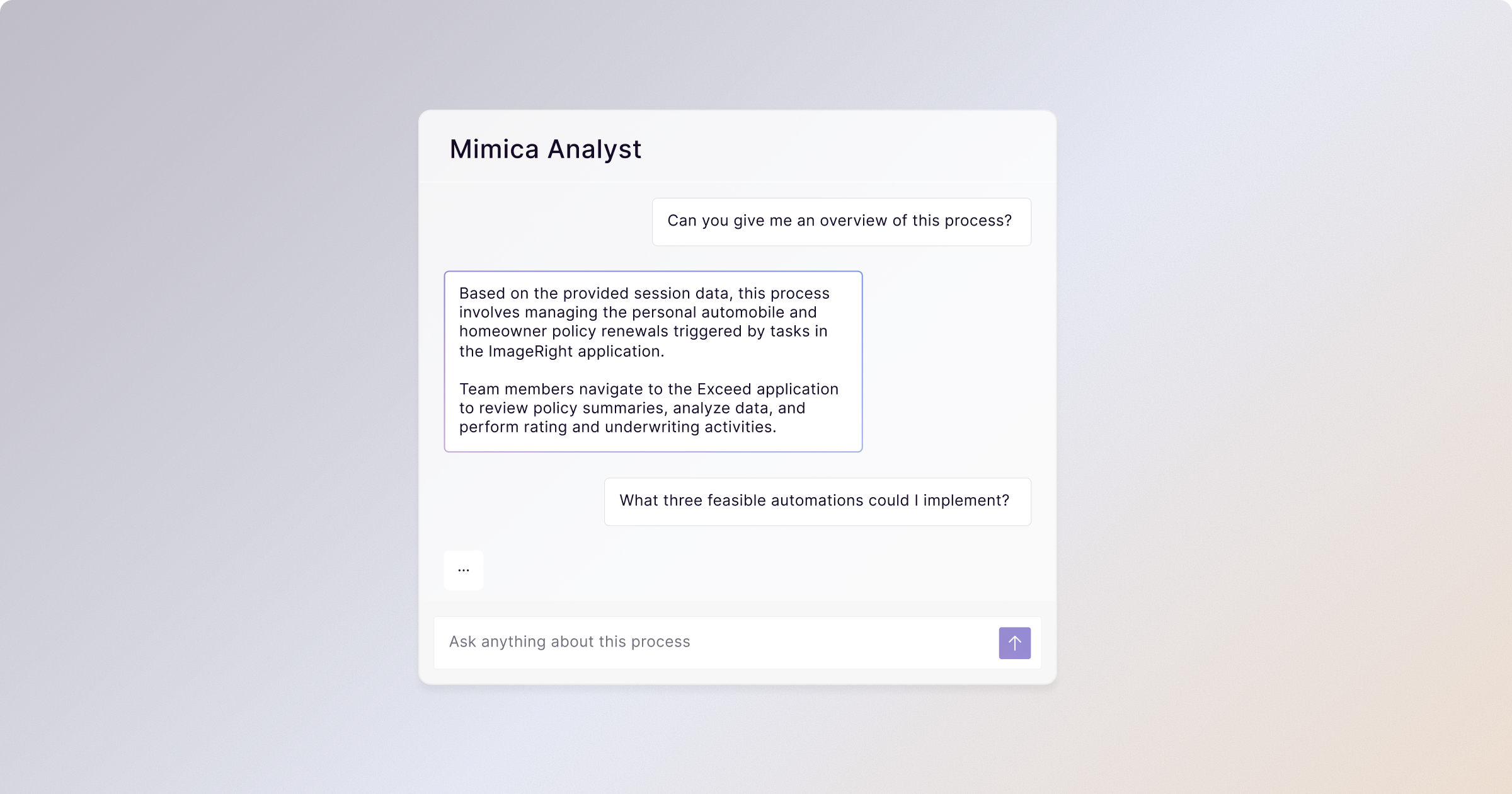
- Mimica Analyst, a conversational interface for querying captured process data directly
- Proprietary automatability scoring, including an Automation Index, an Ease of Automation Score, and flagging of steps that aren't good automation candidates
- Click-level (L5) process maps, the most granular tier in this category's typical process-mapping hierarchy, which runs from broad end-to-end views (L3) down to individual clicks (L5)
- Exports process description documents (PDDs), standard operating procedures, and structured data ready for RPA or agentic AI development
- Fast time to value, with no professional services required
- Named a Leader and Star Performer in Everest Group's Digital Interaction Intelligence Products PEAK Matrix for four consecutive years (2023–2026), and rated 4.8/5 on Gartner Peer Insights
Ideal for: Enterprise ops and IT teams that need accurate, privacy-safe, granular process data to power RPA programs, SOP generation, or agentic AI deployments across complex, multi-system environments.
2. Skan.ai
Skan AI combines task mining with a proprietary AI approach to extract process data across legacy mainframes, virtual desktop infrastructure (VDI), and modern applications alike. It observes work continuously in the background and stitches human actions across applications and multiple days into a case-level view.
Key strengths:
- Passive, continuous observation with no active recording sessions required
- Extracts process data across legacy and modern applications alike
- Produces multi-level process maps, down to the overview-step tier
Trade-offs:
- Deployment involves extensive configuration and manual data labeling, which extends time to value
- Typical time to value runs four-plus months, considerably longer than platforms designed for rapid deployment, and requires professional services to operationalize insights
- Does not produce click-level (L5) process maps, the most granular tier in this category
- Report customization and dashboard changes require going through Skan's platform team rather than self-service tools
Ideal for: Organizations that can absorb a longer implementation timeline and have professional services budget available, particularly for high-level process analysis rather than hands-on automation development.
3. KYP.ai
KYP.ai positions itself as an agentic process intelligence platform rather than a task mining tool, capturing activity continuously across desktop applications and websites with on-device anonymization. It calculates automation ROI automatically and can generate agent code deployable on platforms like UiPath, SAP Joule, and Copilot Studio without manual coding.
Key strengths:
- Calculates automation ROI automatically, without manual spreadsheet modeling
- Generates ready-to-deploy agent code for multiple platforms
- Anonymizes data on-device, with no screenshots stored or transmitted
- Strong fit for benchmarking productivity across large, distributed teams
Trade-offs:
- Measures time spent at the application and website level only, not the task, process, or individual case level, which limits how deep the coverage actually goes
- Does not produce process maps at any level of granularity, which limits its use as a baseline for agentic AI design despite its positioning in that space
- Identifying non-value-added work requires extensive manual labeling and preconfiguration
- Smaller customer base than established category leaders, which may matter to buyers weighing vendor longevity
Ideal for: Organizations needing workforce productivity benchmarking and automatic ROI quantification at the application level, particularly business process outsourcing (BPO) firms and shared services teams with existing UiPath or SAP infrastructure.
4. UiPath Task Mining
UiPath established itself as a market leader in RPA before expanding into task mining to complete its automation lifecycle. Task Mining integrates directly with UiPath Studio and Automation Hub, feeding discovered automation candidates straight into bot development, though recording is SME-initiated after UiPath retired its continuous, unassisted option in December 2025.
Key strengths:
- Integrates directly with UiPath's automation and bot development tools
- Tracks ROI by comparing pre- and post-automation performance
- Included in existing UiPath platform licensing, with no separate task mining fee
- Automatically clusters similar screens and actions
Trade-offs:
- Recording now requires SME-initiated sessions and manual setup for each one, since the continuous, unassisted option was deprecated in December 2025
- Optimized specifically for RPA use cases, which can mean overlooking process improvements that don't involve bot deployment
- Visualizing complete end-to-end processes across multiple systems typically requires pairing with UiPath Process Mining
- Value proposition weakens significantly outside the UiPath ecosystem
Ideal for: UiPath customers who want a governed, closed-loop pipeline from process discovery straight through to bot deployment, without needing granular, click-level process maps.
5. Automation Anywhere
Automation Anywhere offers Process Discovery as an add-on module within its broader RPA platform, pairing discovery with rapid bot delivery in one ecosystem. It uses computer vision to capture task-level activity across desktop, VDI, mainframe, and legacy systems, then auto-generates documentation to hand off to automation teams.
Key strengths:
- Auto-generates documentation directly from captured activity
- Captures activity across virtually any environment, including mainframe and legacy systems
- Feeds discovered automation candidates directly into bot development
- Scores automation candidates by expected ROI
Trade-offs:
- Discovery is optimized for RPA-ready work, which can mean overlooking process improvements that don't involve bot deployment
- Requires deploying and configuring desktop agents across the user population before any data can be captured
- Creates vendor lock-in as a discovery tool tightly bound to the Automation Anywhere ecosystem
- Sold as an add-on module on top of core platform licensing, rather than as a standalone product
Ideal for: Organizations already committed to Automation Anywhere's RPA platform that want to accelerate the handoff from discovery to automation within a single vendor environment.
6. Celonis Task Mining
Celonis pioneered commercial process mining and remains the category leader, with the largest customer base and deepest enterprise resource planning (ERP) event log correlation in the market. Its Task Mining Client installs on user desktops to capture keystrokes, mouse clicks, and configurable screenshots, then fuses that data with server-level process mining.
Key strengths:
- Deepest ERP event log correlation of any tool in this category
- Unifies desktop-level human activity with enterprise system data in one model
- Processes high data volumes incrementally, with fast-refreshing dashboards
- Connects directly to the Celonis Execution Management System for automated action
Trade-offs:
- Does not produce structured process maps at any level of detail, limiting visibility into exactly how a process runs step by step
- Does not calculate automation ROI automatically; translating captured data into a business case requires manual analysis
- Positioned as an add-on to the core Celonis platform rather than a standalone product, and requires manual preconfiguration to move from raw activity capture to actionable insight
- Workforce productivity benchmarking measures capacity against a standard workday rather than against individual case-level variation
Ideal for: Organizations already running Celonis for process mining that want to add desktop-level context to existing process data, without needing granular, click-level process maps.
7. IBM Process Mining
IBM combines process mining with task-level capture as part of its broader automation and AI portfolio, targeting organizations that need governed discovery of manual work within complex, regulated processes. It comes with comprehensive audit trails, role-based access controls, and compliance frameworks built for financial services, healthcare, and pharma.
Key strengths:
- Comprehensive governance and compliance features built for regulated industries
- Integrates with IBM's broader automation and AI portfolio
- Automatically identifies automation opportunities and generates RPA bot scaffolds
Trade-offs:
- Implementation complexity can extend deployment timelines well beyond lighter-weight, faster-to-value alternatives
- Full value typically requires broader investment in IBM's ecosystem rather than standing alone
- Steeper learning curve for business users extracting insights independently
- Best suited to organizations with dedicated IT resources to manage integration and ongoing configuration, given the platform's enterprise scope
Ideal for: Enterprises standardizing on IBM infrastructure that need governed process discovery with deep compliance and audit capabilities.
8. ABBYY Timeline
ABBYY Timeline is a cloud-based process intelligence platform spanning five capabilities: process discovery, analysis, monitoring, prediction, and simulation. It's particularly strong in document-heavy industries, pairing process and task mining with ABBYY's intelligent document processing (IDP) technology for organizations handling high volumes of contracts, claims, and invoices.
Key strengths:
- Combines process mining, task mining, and document processing in a single platform
- Predicts likely process outcomes before a process completes
- Strong fit for document-heavy industries like finance, insurance, and legal
Trade-offs:
- Category mindshare has declined to 1.7% as of January 2026, down from 2.1% the year before, per PeerSpot's engagement-based tracking
- Offers a documented REST API and Postman collection, but lacks native out-of-the-box connectors to third-party automation orchestrators outside its own ecosystem, which means more integration work for teams building on other platforms
Ideal for: Industries processing high volumes of unstructured documents, such as financial services, insurance, legal, and healthcare, where process intelligence needs to span structured workflows and document processing together.
9. Microsoft Power Automate
Microsoft built process and task mining into Power Automate's Process Advisor feature, integrating task capture with the platform's low-code automation tools. It targets Microsoft-centric organizations that want unified governance and familiar tooling across their automation initiatives, bundled into the Power Automate Premium tier.
Key strengths:
- Built into the Microsoft 365 ecosystem, including Teams, Dynamics 365, and Power Platform
- Low-code automation accessible to non-technical users
- Governed through existing Microsoft compliance and security tools
- Bundled into existing Power Automate licensing, with no separate task mining fee
Trade-offs:
- Limited visibility into non-Microsoft applications and processes, narrowing coverage for organizations running a mixed technology stack
- Desktop capture capabilities are less mature than those of vendors purpose-built for task mining
- Measuring time across tasks and processes requires manual labeling and preconfiguration rather than automatic analysis
- Less robust for organizations running a heterogeneous mix of legacy systems and third-party platforms
Ideal for: Microsoft-centric organizations that want a low-friction, low-cost entry point into task mining within their existing M365 environment.
10. Soroco Scout
Soroco built its platform around "work graphs," interactive visualizations that map how work flows across people, teams, systems, and applications. Rather than focusing purely on automation-ready discovery, Scout prioritizes revealing handoffs, collaboration patterns, and dependencies that traditional process maps miss.
Key strengths:
- Visualizes how work flows across teams and systems, revealing handoffs that traditional process maps miss
- Tracks how employees adapt to new systems over time
- Scrubs sensitive data at the source before it leaves the system
Trade-offs:
- Sophisticated visualizations require time and analytical expertise to interpret effectively, rather than being usable out of the box
- Extracting value typically requires dedicated analysts rather than self-service tools
- Less emphasis on direct automation pipeline output compared to RPA-centric platforms
- Does not offer automatability scoring or calculate automation ROI automatically
Ideal for: Large enterprises prioritizing cross-team work pattern analysis and change management over direct RPA pipeline creation.
Which task mining tool should you choose?
The right task mining tool depends on your use case, your existing ecosystem, and your compliance requirements. Organizations locked into a specific RPA or ERP platform get the most value from tools built natively into that ecosystem. Organizations that need data fast, particularly those building toward agentic AI, need a platform that captures how work actually happens without months of setup or professional services.
That's the gap Mimica closes. Mimica records desktop activity across every application, automatically redacts personally identifiable information with no manual configuration required, and turns that into click-level process maps, automation priorities, and an AI-ready roadmap, typically within weeks rather than months. It's also built to complement existing RPA and ERP investments rather than replace them, so organizations already running UiPath, Celonis, or similar platforms don't need to abandon that infrastructure to get ground-truth process data; Mimica's output feeds directly into the automation stack they already have.
Request a demo to see how it works with your own processes.
FAQ
What are task mining tools?
Task mining tools capture desktop-level human behavior, such as keystrokes, clicks, and application navigation, to reveal how work is actually performed and where automation opportunities exist. Platforms like Mimica capture that behavior with enough structure and granularity to function as a process mining input on its own.
What's the difference between task mining and process mining?
Task mining captures desktop-level human behavior to show how individual employees perform their work, including manual steps in spreadsheets, email, and other applications that never touch a system log. Process mining analyzes system event logs from ERP, CRM, or other enterprise platforms to reconstruct process flows without observing individual users. One reveals the human layer of a process; the other reveals the system layer. The two are complementary, not competing: the most complete picture of a process combines both.
What are the top process mining tools?
Process mining tools analyze system event logs from ERP, customer relationship management (CRM), and other platforms to reconstruct process flows without observing individual users. IBM Process Mining and ABBYY Timeline offer dedicated process mining alongside task-level capture. But process mining alone only sees what happens inside enterprise systems, missing the manual work in spreadsheets and email that task mining is built to capture. Platforms like Mimica generate structured process data granular enough to serve as a process mining input on its own.
Which task mining tool delivers the strongest ROI?
It depends on how quickly you need a return. Microsoft Power Automate requires the least additional procurement, since it's bundled into existing Power Automate Premium licensing, though its analysis still requires manual labeling before ROI becomes clear. Mimica skips that step entirely: automatic ROI quantification, no professional services, and results in weeks rather than months, where regulated enterprises see the fastest return.
What should regulated industries prioritize in a task mining tool?
For audit-grade evidence and GRC alignment, Celonis and IBM Process Mining correlate desktop activity with system-of-record logs. For industries where the recording itself is the bigger risk, Mimica automatically detects and redacts personally identifiable information with no manual configuration required, making it a strong fit for financial services, healthcare, and government buyers.
What role does task mining play in deploying AI agents?
AI agents need more than a list of steps to run unsupervised; they need the decision logic, exceptions, and escalation paths a human applies without thinking. Task mining captures that context from observed behavior and structures it for an agent to use. Mimica is built for this: it exports process context ready for agent development, not screenshots that still need manual translation.





.svg)
.svg)
.svg)
