

Process mining is the method of reconstructing and analyzing how business processes run using data from the enterprise systems that already record them.
What is Process Mining?
Process mining is the method of reconstructing and analyzing how business processes run using data from the enterprise systems that already record them. Instead of relying on interviews or workshops, process mining uses real-world data to determine how people work. It matters because the process that's documented almost never matches the process that's actually followed, and that gap is usually bigger than leadership expects.
How does process mining work?
Process mining works by using system event logs to assemble an evidence-based picture of operations.
The reality is every enterprise system leaves a trail. When someone logs a purchase order in an ERP, approves an invoice, closes a support ticket, or updates a customer record, the system timestamps it: who did what, in what sequence, with what outcome. Those records are called event logs, and process mining uses them to assemble an evidence-based picture of your operations. Think of it like forensics: the case files are already there, scattered across your SAP instance, your Salesforce environment, your ticketing system. Process mining is the method that assembles them into a coherent story.
At a high level, process mining works in three stages:
- Event logs are extracted from source systems: ERP platforms, CRM tools, service desk software, financial systems, and document management platforms. Each log entry captures three things: a case (the unit of work, such as a purchase order or a loan application), an activity (what happened), and a timestamp.
- Algorithms process those logs to reconstruct process flows. The output is a visual process map showing the most common paths through a process, how frequently each path occurs, and where time or volume is concentrated. More sophisticated tools can also surface conformance gaps, where the process deviates from a defined standard, and benchmark performance across teams, regions, or time periods.
- Process owners and analysts use that data to make decisions: where to reduce bottlenecks, which process variants to standardize, where automation would deliver the highest return, and which compliance risks need attention.
The result is a process map, and not the one living in a PowerPoint from 2019. This one reflects reality: you can see which paths through a process are most common, which variants are slowest, where volume accumulates, and where cases fall off the edge. The advantage over traditional approaches, like workshops, interviews, and direct observation, is speed, scale, and objectivity — a process mining tool can analyze millions of event records in the time it takes to schedule a workshop, and the data doesn't depend on anyone's memory or willingness to describe how they actually work. That's the honest appeal: process mining bypasses one of the oldest problems in process improvement, which is that people describe processes as they're supposed to work, not as they do work. Event logs don't have that bias.
What does traditional process mining miss?
The problem with traditional process mining is that it can only analyze what your systems log, and a substantial share of enterprise work never touches a system log at all.
For highly structured, system-driven processes like accounts payable, order management, or employee onboarding, that's often sufficient. Most of the meaningful activity happens inside an ERP or a service desk, and the event logs capture it reasonably well.
But a substantial share of enterprise work happens in the gaps between systems. A claims adjuster who copies data from one platform to another because the integration doesn't exist. An underwriter who runs through a checklist in a spreadsheet before updating the policy system. A customer service rep who navigates three screens in a specific sequence before responding to a query. None of that shows up in an event log.
For knowledge-intensive work, and most enterprise functions have a lot of it, traditional process mining produces an incomplete picture. The map looks clean because the data is clean, not because the process is clean.
This isn't a criticism of the concept. The technique is powerful within its scope. But organizations that need a full-fidelity picture of how work actually happens, including the desktop activity that never touches a system log, need something that goes further.
What is process intelligence, and how does it go further?
Process intelligence extends what process mining started by capturing the full picture of how employees work, not just what shows up in system logs — every application they use, every step they take, every data entry and screen transition, across the entire desktop environment.
That activity gets recorded, anonymized, and analyzed by AI at scale, across thousands of employees, running in parallel. The output isn't just a process map. A mature process intelligence platform delivers ranked automation opportunities so teams know which candidates will deliver the highest return, productivity benchmarks so leaders can identify where performance varies and why, and detailed process documentation that reflects actual behavior rather than intended behavior.
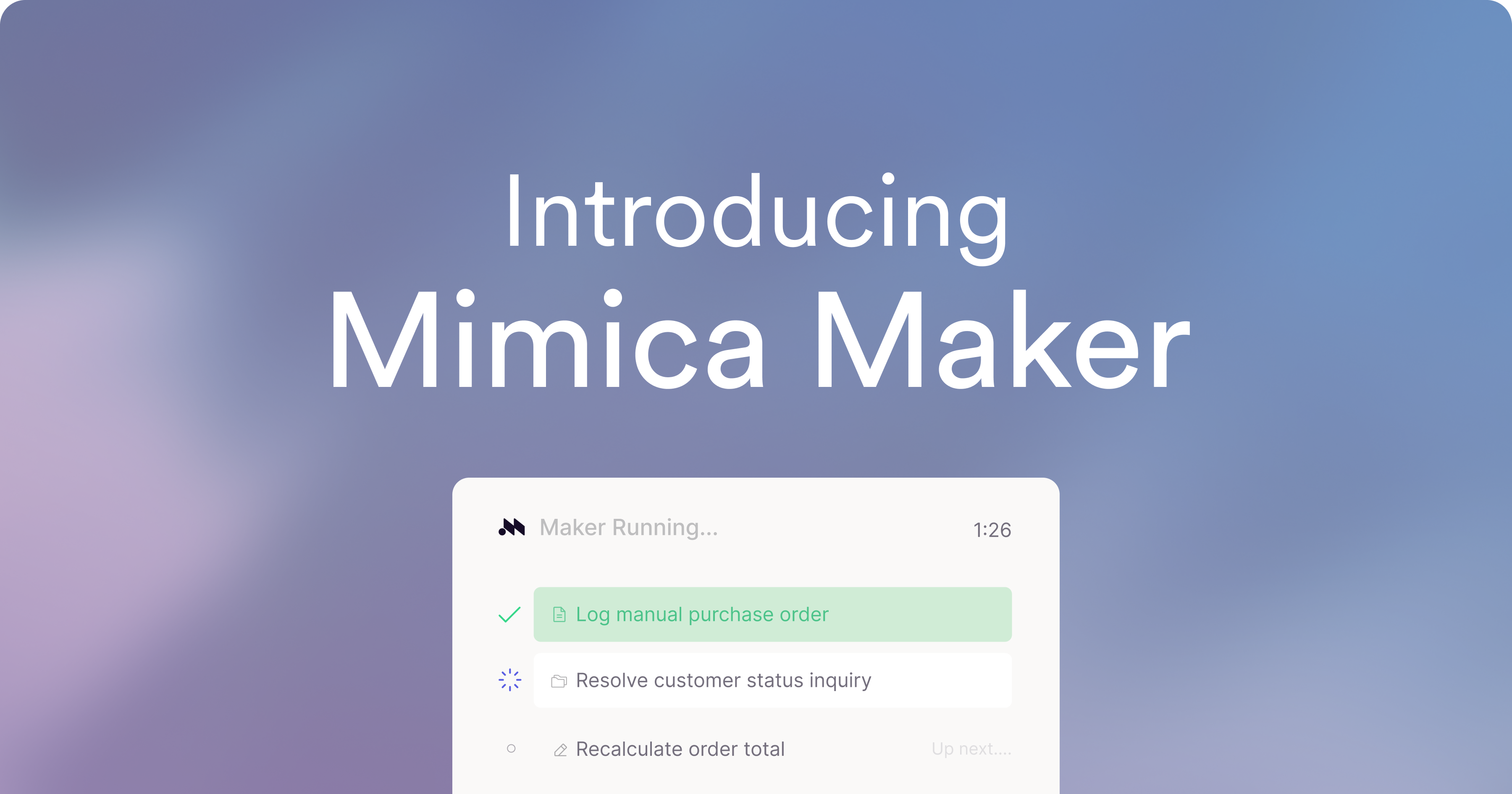
Mimica is built on this model. Its platform records desktop activity across employee populations, uses AI to surface patterns and anomalies, and presents findings through a suite of tools: Miner for discovery and prioritization, Mapper for process documentation, Measure for benchmarking, Maker for building automation, and Analyst for querying recorded data directly.
The distinction matters because the question transformation leaders are actually trying to answer isn't "what do our system logs say?" It's "how does work actually get done, and what should we change about it?"
Why does process mining matter right now?
Process mining matters now because automation decisions, AI readiness, and cost pressure all depend on knowing how work actually happens.
Automation decisions. The ROI on any automation investment depends on choosing the right processes. Automating a broken process produces broken results, faster. Process mining gives transformation teams the data to make those choices on evidence rather than advocacy.
AI readiness. As enterprises deploy AI agents and copilots across their operations, the same challenge applies. AI performs best on processes that are well-defined, consistent, and documented. Process mining surfaces that picture and reveals where processes need to be standardized before AI can be effectively applied.
Cost and efficiency pressure. Rework, unnecessary handoffs, redundant steps, and idle time are expensive, but they're invisible without data. Shared services and operational excellence teams face constant pressure to squeeze more from existing resources. Process mining makes the waste visible.
Transformation teams who can't answer basic questions about their current-state processes, including how long they take, how many variants exist, and where errors occur, are operating with a significant blind spot.
What's possible with process mining?
The organizations getting the most value from process intelligence use it as an ongoing operational layer, not a one-time diagnostic: continuously monitoring how work runs, tracking whether changes land as intended, and making prioritization decisions from data rather than intuition.
That's a real shift from how transformation has traditionally worked, built around consulting engagements, workshop cycles, and the institutional memory of a few internal experts. Continuous process intelligence means those decisions can be faster, more grounded, and better scoped to where the actual opportunity is.
Process mining opened this possibility by proving that process data, drawn from the systems already running your business, could replace assumption with evidence. Process intelligence takes that foundation further, extending the picture to cover the full reality of how your organization works.
Process mining is often confused with task mining, but they start from different data. Task mining captures desktop-level activity to surface automation opportunities within a single role or task, while process mining reconstructs how a process flows across systems and people from structured event logs.
For transformation leaders making decisions about automation, AI adoption, and operational efficiency, that fuller picture is the starting point for almost everything else.

.png)

.svg)
.svg)
.svg)
