

Mimica Mapper can generate a complete, accurate SOP from any process map in a single click. The SOP is built directly from recorded workflow data, so it reflects how work actually runs today, not how it was documented the last time someone found the time to update it.
What if your process documentation always reflected how work actually runs today? Not how it was written up five years ago, not how someone described it in an interview, but the real day-to-day reality, across every role and system?
Mimica Mapper automatically generates complete, accurate SOPs directly from any process map with a single click.
Mimica SOPs are extremely accurate because they’re based on real-world data of how the work is actually done at a click and keystroke level across the entire desktop. Even better? There’s no manual effort needed to produce these SOPs, they’re automatically generated.
SOPs that are one-to-one reflections of real life work lead to smarter training, faster onboarding, and more consistent output across the entire organization.
For organizations that want to ensure their SOPs are as accurate and detailed as possible, Mimica is the clear choice.
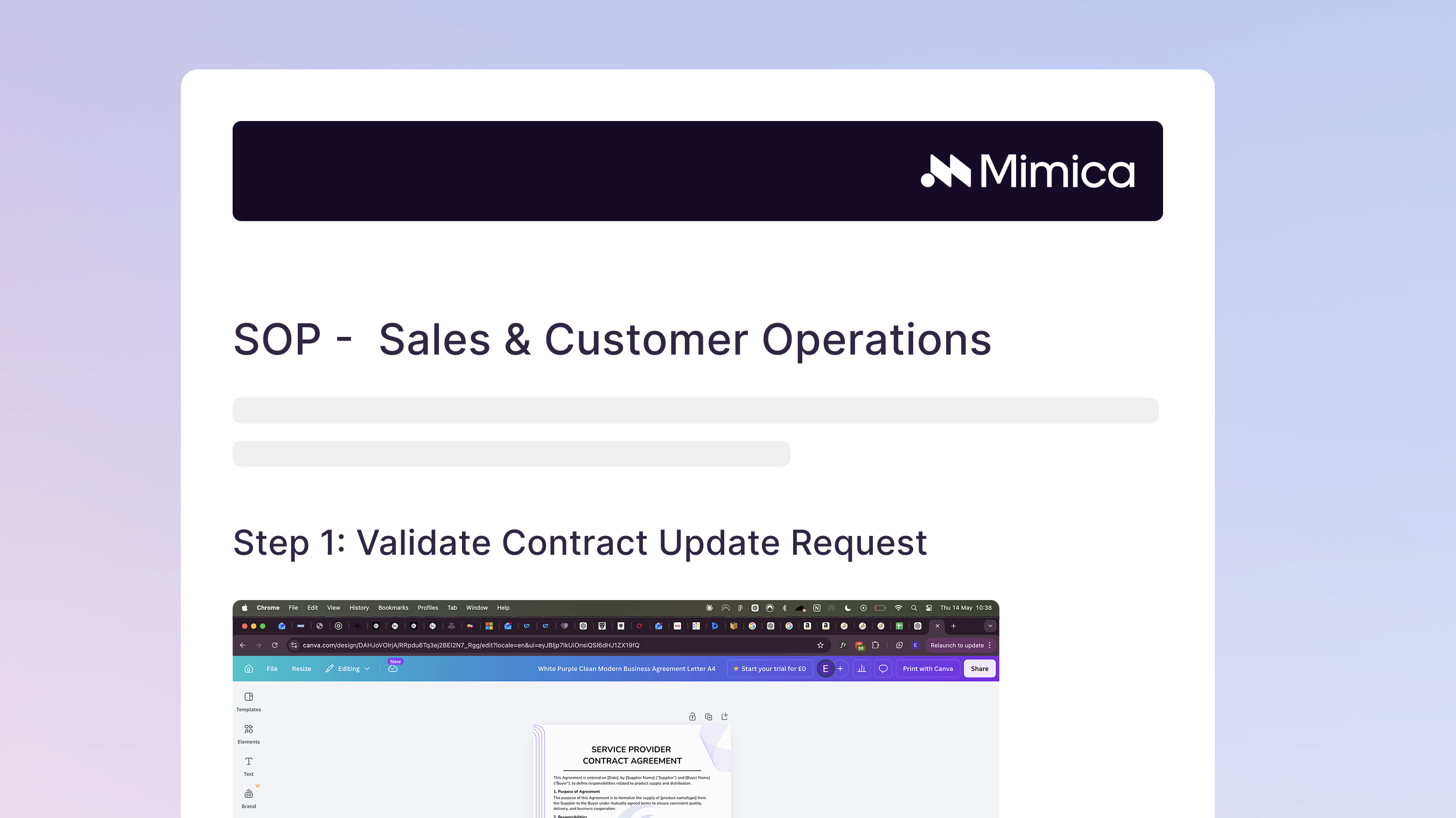
What's included in Mimica SOPs
Mimica SOPs are generated as structured, ready-to-use documents that include everything a team needs to understand, execute, and share a process:
- A process summary
- Step-by-step instructions
- Screenshots
- Systems and applications used
- Version history
- An image of the full Mimica process map
Mimica builds the most accurate SOPs based on workflows, they can also be enriched with human context (such as best practices) before or after export, giving an extra layer of control.
Why this matters: the problem with traditional SOPs
SOPs can become ineffective because the inputs that go into them, including interviews, observation sessions, and memory, cannot keep pace with how work actually changes.
Ask someone how they complete a task and they will tell you the official version. They will not mention the step where they export data to Excel and re-import it because a system integration was never fixed. They will not flag the shortcut that every experienced employee uses but nobody has formally approved. The workarounds, the variations, the muscle memory that keeps operations running, none of it makes it into the document.
Brandy Hulsey, VP of Enterprise AP & Reverse Logistics at McKesson, acutely felt the pain of out-of-date SOPs before turning to Mimica:
"We have a lot of people that can do really great things, but they can't tell you how they do it, because they just do it second nature. We have outdated SOPs that are 30 pages long, that really don't help us efficiently navigate processes when we do have to leverage those documents."
The result is a process document that quickly becomes out of date or fails to incorporate variations that could lead to a more optimized workflow.
But when the process map is generated from what people actually do, every click, every application, every sequence, the SOP built from it reflects the process as it runs today, not as it was designed to run two years ago. Starting with observed behavior changes the equation entirely.
Keeping SOPs current stops being a recurring headache
The second problem with traditional SOPs is maintenance. Documents go stale fast. But it’s hard to justify the time and effort to repeat the documentation exercise every time a process changes.
With Mimica, re-exporting an SOP takes one click. When a process evolves, whether a new system is introduced, a better method is identified, or a team changes how they handle exceptions, update the process map and re-export. Version history is built in. The document always reflects the current state of the map.
This shifts SOP maintenance from an occasional project that never quite gets prioritized to a routine action that takes seconds.
How teams are using SOP exports
Training and onboarding: New team members get instructions that reflect how the process actually runs today, ensuring standardized onboarding. The SOP becomes a genuine training tool rather than a formality.
Standardizing execution across teams: When Mimica captures how different employees complete the same task, it surfaces variation. Some of that variation is inefficiency. Some of it is a better way of working that one person discovered and nobody else knows about. SOPs become the mechanism for making the best version of a process the standard version, consistently, across every team member.
Supporting change management and process improvement: When a process is improved or a system changes, an accurate baseline makes everything easier: tracking what changed, communicating the update, retraining teams, and measuring adoption over time. SOPs generated from Mimica maps provide that baseline automatically.
SOPs as the foundation for AI and automation
There is a broader reason why accurate process documentation matters more now than ever.
AI agents and automation tools are only as good as the task designs they are built on. If an automation is designed from a three-year-old SOP, the resulting process description encodes the wrong version of reality, and the automation reflects that.
SOPs generated from observed task data close that gap. They give automation developers, AI engineers, and process teams a foundation that reflects how work actually runs, making every downstream initiative more accurate, more reliable, and faster to build.
Want to see how automated SOPs can help your organization? Request a demo today.
.png)





.svg)
.svg)
.svg)
