
A time and motion study measures how long a task takes and how it gets done, so teams can set a standard time and remove wasted steps. Operations and continuous improvement teams use time and motion studies to plan staffing, standardize processes, and find opportunities to improve.
Traditional studies rely on an observer timing the work in person, which gets difficult in an office: much of the work moves between applications on a screen, and people tend to work differently with someone looking over their shoulder. An AI-powered time and motion study measures that digital work directly, across every transaction. This guide covers what a time and motion study is, how to run a traditional one, what an AI-powered study adds, and how the two compare, then how to turn the results into automation.
What is a time and motion study?
A time and motion study is a work measurement method that breaks a task into steps, times each one, and analyzes how the work gets done to set a standard time and find a better method. The standard time is how long a trained person needs to complete the task at a normal pace, with allowances for fatigue and unavoidable delays.
The method combines two disciplines: time study measures how long work takes, and motion study examines how it gets done. Teams run them together because a standard time built on a wasteful method just locks the waste in. The pairing traces back to Frederick Winslow Taylor's time studies and Frank and Lillian Gilbreth's motion studies around the turn of the 20th century.
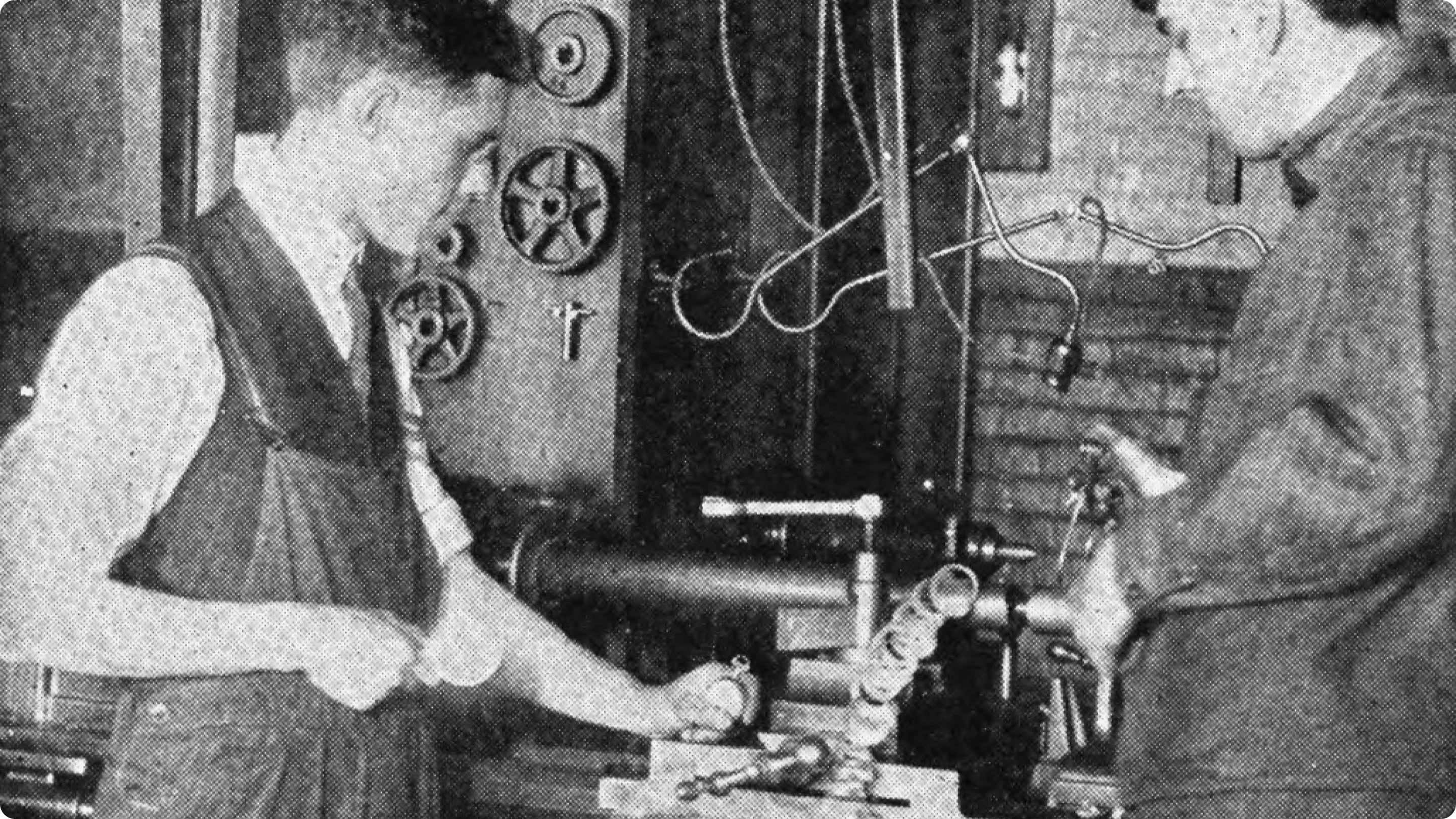
How do you conduct a traditional time and motion study?
To conduct a traditional time and motion study, follow six steps: define the task, break it into elements, time several cycles, rate the pace, add allowances, and calculate the standard time.
- Define the task. Name the work, where it starts and ends, and the conditions it runs under.
- Break it into elements. Split the task into the smallest distinct steps you can time.
- Time several cycles. Observe the task repeatedly with a stopwatch or video and record each element.
- Rate the pace. Adjust the observed times to reflect a normal working speed.
- Add allowances. Account for fatigue, personal needs, and unavoidable delays.
- Calculate the standard time. Combine the normal time and allowances into a single benchmark.
This method works well for repetitive physical tasks with a clear start and finish, however, each study takes significant manual effort: an observer on site for every session, and a fresh start for every rerun. The method gets harder still when a single case touches several applications and takes a different path depending on the input.
What is an AI-powered time and motion study?
An AI-powered time and motion study measures digital work by capturing desktop activity across a team for a defined time period or window, typically about two weeks, then using AI to identify the tasks, time every step, and map how the work actually flows. It answers the same two questions as a traditional study, how long and how, but across every transaction instead of a handful of manually observed cycles.
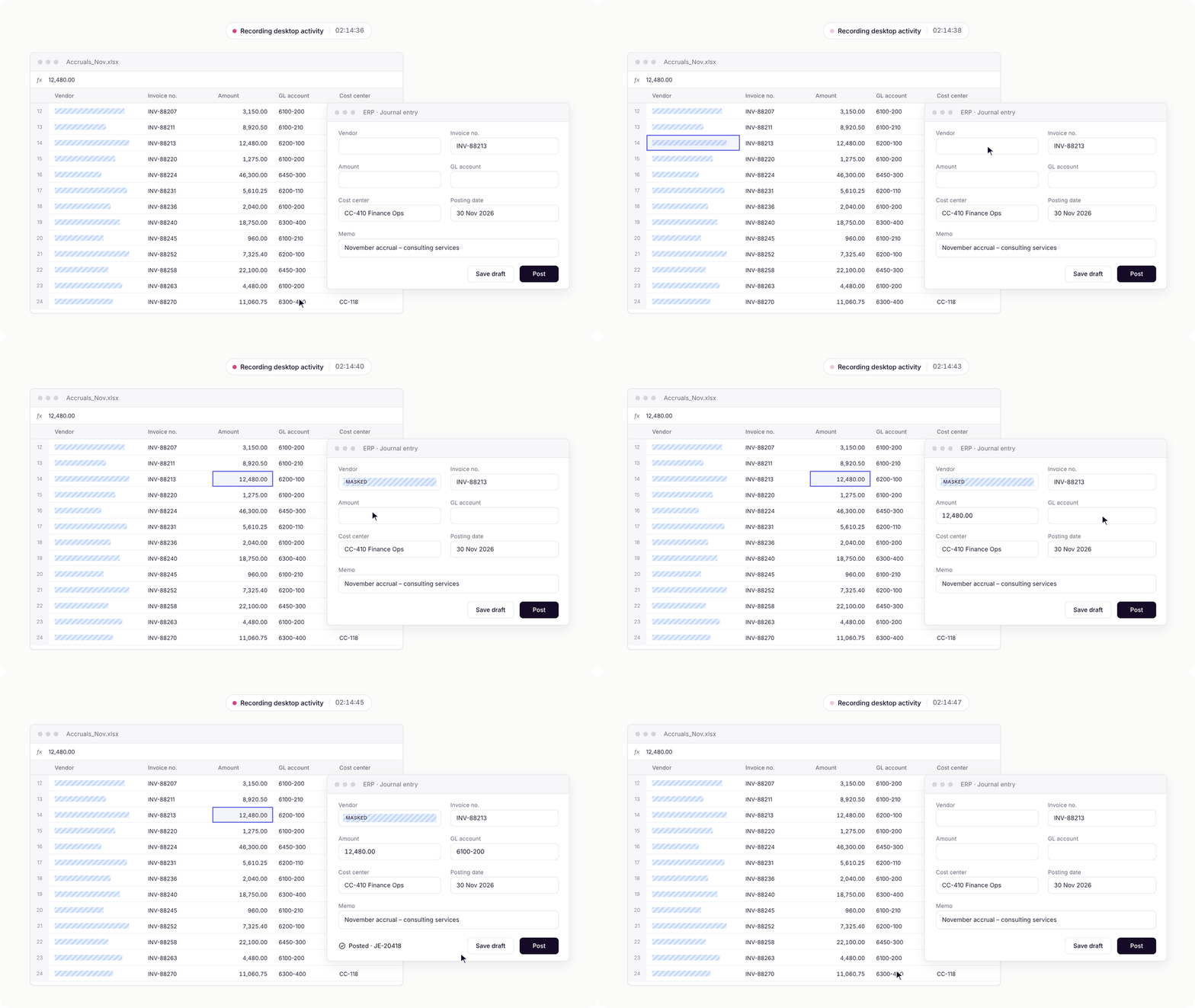
A process intelligence platform like Mimica runs these studies in four stages:
- Capture. A lightweight recorder logs desktop activity for a representative group over a defined window, masking sensitive data along the way.
- Identify. AI groups the activity into tasks and steps, and the team's subject matter experts confirm the results.
- Measure. The study calculates time per task and step across every instance, plus the variation between teams, sites, and points in the month.
- Map. Process maps show the common path through the work, along with the variants and exceptions.
The biggest advantage lies in what the study can see. Much of back-office work happens between systems, in spreadsheets, email, and copy-and-paste between applications. Steve Carpenter of Merck described this in a Mimica webinar about the month-end close: "There's a lot of work that goes into creating journal entries and closing the books, but most of that work doesn't happen in the system."
The boundary is just as clear: an AI-powered study measures work that happens on a screen. Physical tasks still call for traditional observation, but for knowledge work and back-office operations, the screen is where the work lives.
How do traditional and AI-powered time and motion studies compare?
Traditional time and motion studies measure what an observer can see in a few sessions, while AI-powered studies measure digital work across every transaction over a defined window. The AI-powered approach produces a larger, more representative sample with less manual effort. Traditional studies still work best for physical and manual work.
What can you do with time and motion study results?
Teams use time and motion study results to plan staffing, benchmark across sites, find automation candidates, and prove that a change worked:
- Staffing: Accurate standard times and workload analysis show where capacity matches demand and where it doesn't.
- Benchmarking: Comparing the same process across locations shows which approach works best and where to standardize.
- Automation: Repetitive, rules-based steps stand out once every step is timed.
- Change management: Rerunning the study after a new tool or process goes live shows whether the work actually changed.
A global logistics provider used this approach ahead of a customs clearance system migration. Instead of spending months on disruptive manual time studies, the team captured 20 times more data than it could compile by hand and cut cycle times before rebuilding the processes in the new system. After the switch, it set new performance benchmarks for the whole customs clearance organization, and within three weeks of the transition, it showed executive leadership a clear return on the investment.
How do you turn time and motion study results into automation?
To turn time and motion study results into automation, start with the steps the study shows are repetitive, rules-based, and time-consuming, then build agents from the same process maps the study produced. Because the study already captured every variant, exception, and decision in the work, it doubles as the requirements for the automation.
Not every step should go straight to automation. Sometimes the right move is to eliminate a step or standardize a process first, so you don't automate a workaround. The strongest candidates share a few traits:
- Volume: The task runs often enough that the time saved adds up.
- Rules: Decisions follow clear logic the study can document.
- Consistency: Most cases follow the common path, and the study has already mapped the exceptions.
Mimica’s platform closes the gap between measurement and automation. The process maps from the study feed Mimica Maker, an agentic automation platform that generates the code for a working AI agent directly from that map. Your team reviews and approves a blueprint of what the agent will do before it runs, every agent is tested against the real cases observed during the study, and anything unfamiliar goes to a person instead of being guessed at. An agent can be ready in as little as 24 hours.
Then the study comes full circle: rerun it after the agent goes live to measure how much time came back to the team, and where people now spend it.
See how your work actually runs
An AI-powered time and motion study shows how your digital operations really run, across every transaction, and where automation can take over the repetitive work. Book a demo to see what a study looks like for your processes.
Frequently asked questions
What's the difference between a time study and a motion study?
A time study measures how long a task takes in order to set a standard time. A motion study examines how the task is performed in order to find a simpler, faster method. Most practitioners combine the two.
How long does a time and motion study take?
A traditional study takes hours to days of observation per task, plus analysis. An AI-powered study typically records for about two weeks, or longer when the work follows a monthly cycle such as a month-end close.
Can you use a time and motion study for office work?
Yes. Traditional observation struggles with screen-based work spread across applications, but an AI-powered study measures that work directly, across every transaction.
How do you automate a time and motion study?
You can automate a time and motion study by recording desktop activity across a team for a defined window, then using a process intelligence platform to identify the tasks, time each step, and map the work. Subject matter experts review the results instead of timing the work by hand.
Is a time and motion study the same as employee monitoring?
No. A time and motion study runs for a defined period, typically about two weeks, and focuses on how the process works. Employee monitoring tracks individuals on an ongoing basis. Study results go to the people improving the process, not to individual performance reviews, and many employees find them validating: for the first time, the data shows how complex and valuable their work is.
A time and motion study measures how long a task takes and how it gets done, so teams can set a standard time and remove wasted steps. Operations and continuous improvement teams use time and motion studies to plan staffing, standardize processes, and find opportunities to improve.
Traditional studies rely on an observer timing the work in person, which gets difficult in an office: much of the work moves between applications on a screen, and people tend to work differently with someone looking over their shoulder. An AI-powered time and motion study measures that digital work directly, across every transaction. This guide covers what a time and motion study is, how to run a traditional one, what an AI-powered study adds, and how the two compare, then how to turn the results into automation.
What is a time and motion study?
A time and motion study is a work measurement method that breaks a task into steps, times each one, and analyzes how the work gets done to set a standard time and find a better method. The standard time is how long a trained person needs to complete the task at a normal pace, with allowances for fatigue and unavoidable delays.
The method combines two disciplines: time study measures how long work takes, and motion study examines how it gets done. Teams run them together because a standard time built on a wasteful method just locks the waste in. The pairing traces back to Frederick Winslow Taylor's time studies and Frank and Lillian Gilbreth's motion studies around the turn of the 20th century.
How do you conduct a traditional time and motion study?
To conduct a traditional time and motion study, follow six steps: define the task, break it into elements, time several cycles, rate the pace, add allowances, and calculate the standard time.
- Define the task. Name the work, where it starts and ends, and the conditions it runs under.
- Break it into elements. Split the task into the smallest distinct steps you can time.
- Time several cycles. Observe the task repeatedly with a stopwatch or video and record each element.
- Rate the pace. Adjust the observed times to reflect a normal working speed.
- Add allowances. Account for fatigue, personal needs, and unavoidable delays.
- Calculate the standard time. Combine the normal time and allowances into a single benchmark.
This method works well for repetitive physical tasks with a clear start and finish, however, each study takes significant manual effort: an observer on site for every session, and a fresh start for every rerun. The method gets harder still when a single case touches several applications and takes a different path depending on the input.
What is an AI-powered time and motion study?
An AI-powered time and motion study measures digital work by capturing desktop activity across a team for a defined time period or window, typically about two weeks, then using AI to identify the tasks, time every step, and map how the work actually flows. It answers the same two questions as a traditional study, how long and how, but across every transaction instead of a handful of manually observed cycles.
A process intelligence platform like Mimica runs these studies in four stages:
- Capture. A lightweight recorder logs desktop activity for a representative group over a defined window, masking sensitive data along the way.
- Identify. AI groups the activity into tasks and steps, and the team's subject matter experts confirm the results.
- Measure. The study calculates time per task and step across every instance, plus the variation between teams, sites, and points in the month.
- Map. Process maps show the common path through the work, along with the variants and exceptions.
The biggest advantage lies in what the study can see. Much of back-office work happens between systems, in spreadsheets, email, and copy-and-paste between applications. Steve Carpenter of Merck described this in a Mimica webinar about the month-end close: "There's a lot of work that goes into creating journal entries and closing the books, but most of that work doesn't happen in the system."
The boundary is just as clear: an AI-powered study measures work that happens on a screen. Physical tasks still call for traditional observation, but for knowledge work and back-office operations, the screen is where the work lives.
How do traditional and AI-powered time and motion studies compare?
Traditional time and motion studies measure what an observer can see in a few sessions, while AI-powered studies measure digital work across every transaction over a defined window. The AI-powered approach produces a larger, more representative sample with less manual effort. Traditional studies still work best for physical and manual work.
What can you do with time and motion study results?
Teams use time and motion study results to plan staffing, benchmark across sites, find automation candidates, and prove that a change worked:
- Staffing: Accurate standard times and workload analysis show where capacity matches demand and where it doesn't.
- Benchmarking: Comparing the same process across locations shows which approach works best and where to standardize.
- Automation: Repetitive, rules-based steps stand out once every step is timed.
- Change management: Rerunning the study after a new tool or process goes live shows whether the work actually changed.
A global logistics provider used this approach ahead of a customs clearance system migration. Instead of spending months on disruptive manual time studies, the team captured 20 times more data than it could compile by hand and cut cycle times before rebuilding the processes in the new system. After the switch, it set new performance benchmarks for the whole customs clearance organization, and within three weeks of the transition, it showed executive leadership a clear return on the investment.
How do you turn time and motion study results into automation?
To turn time and motion study results into automation, start with the steps the study shows are repetitive, rules-based, and time-consuming, then build agents from the same process maps the study produced. Because the study already captured every variant, exception, and decision in the work, it doubles as the requirements for the automation.
Not every step should go straight to automation. Sometimes the right move is to eliminate a step or standardize a process first, so you don't automate a workaround. The strongest candidates share a few traits:
- Volume: The task runs often enough that the time saved adds up.
- Rules: Decisions follow clear logic the study can document.
- Consistency: Most cases follow the common path, and the study has already mapped the exceptions.
Mimica’s platform closes the gap between measurement and automation. The process maps from the study feed Mimica Maker, an agentic automation platform that generates the code for a working AI agent directly from that map. Your team reviews and approves a blueprint of what the agent will do before it runs, every agent is tested against the real cases observed during the study, and anything unfamiliar goes to a person instead of being guessed at. An agent can be ready in as little as 24 hours.
Then the study comes full circle: rerun it after the agent goes live to measure how much time came back to the team, and where people now spend it.
See how your work actually runs
An AI-powered time and motion study shows how your digital operations really run, across every transaction, and where automation can take over the repetitive work. Book a demo to see what a study looks like for your processes.
Frequently asked questions
What's the difference between a time study and a motion study?
A time study measures how long a task takes in order to set a standard time. A motion study examines how the task is performed in order to find a simpler, faster method. Most practitioners combine the two.
How long does a time and motion study take?
A traditional study takes hours to days of observation per task, plus analysis. An AI-powered study typically records for about two weeks, or longer when the work follows a monthly cycle such as a month-end close.
Can you use a time and motion study for office work?
Yes. Traditional observation struggles with screen-based work spread across applications, but an AI-powered study measures that work directly, across every transaction.
How do you automate a time and motion study?
You can automate a time and motion study by recording desktop activity across a team for a defined window, then using a process intelligence platform to identify the tasks, time each step, and map the work. Subject matter experts review the results instead of timing the work by hand.
Is a time and motion study the same as employee monitoring?
No. A time and motion study runs for a defined period, typically about two weeks, and focuses on how the process works. Employee monitoring tracks individuals on an ongoing basis. Study results go to the people improving the process, not to individual performance reviews, and many employees find them validating: for the first time, the data shows how complex and valuable their work is.


